At the moment, we have the following situation:
Let’s assume two interconnected cisco switches: Switch1 (virtual Nexus 7k instance) -> Port1/1 (Port-Description: nni-switch2) is connected to Switch2 (Nexus 5k) -> Port1/1 (Port-Description: nni-switch1).
We have created an alarm that when a port (Interface-Status) is in Down-State, an email will be sent to us and some other actions will be done (ticket-creation etc.).
Our Problem is the following now:
If we set Switch1 to maintenance mode (Mute Alerts), the switch and all its own ports are muted as expected. Now we take Switch1 offline. Now, we get an alarm for the Port of the second switch which is down now, but it doesn’t make sense because we know that switch1 is away, we have set it to maintenance mode.
Calculate dependencies automatically is set to ‘on’, but it seems that not all dependencies are considered or calculated correctly here. In the Map of Switch1, we see that it is connected to Switch2, so if we set Switch1 to maintenance mode (mute alerts on node level), we don’t expect/want any alarms for the connections to this device!
Layer2-Topology has to be taken into consideration!
Our Example:
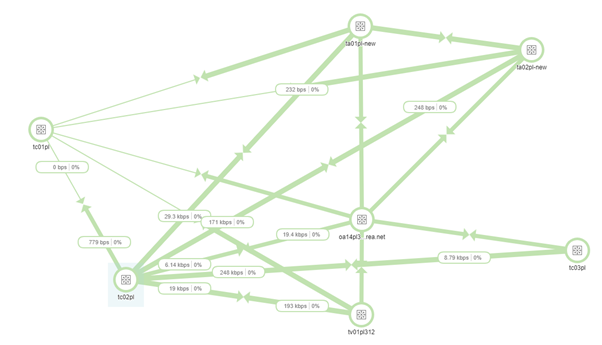
tc02pl: alarms are muted on node level,
ta01pl-new (Port: 1/4 – Description: nni- …) connects to tc02pl (Port: 18/7 – Description: nni-…).
Alarm is defined that Ports with Description nni-.* have to be alarmed.
Due to tc02pl being muted (maintenance), we don’t want Ports of other Switches which connect directly to the device in maintenance mode being alarmed.
tc02pl is an virtual Nexus 7000 instance, ta01pl is an Nexus 5000 Device.
Only the following dependencies are calculated


We need the feature to use dependencies when muting alerts, so interfaces on directly connected devices are not alerting when one device is muted.